


Market Summary
According to our latest research, the GNSS Reflectometry Payload market size in 2025 has reached USD 551 million globally, reflecting robust growth momentum driven by increasing investments in remote sensing and earth observation technologies. The market is exhibiting a healthy compound annual growth rate (CAGR) of 14.3% from 2026 to 2034, with projections indicating the market will attain a value of approximately USD 1.73 billion by 2034.
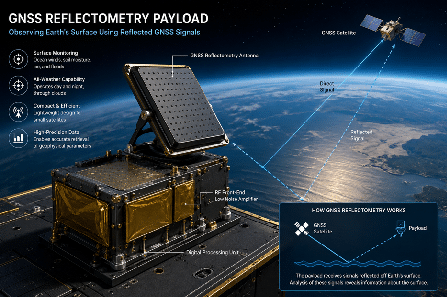
The GNSS Reflectometry Payload Market is emerging as an important segment within the broader satellite remote sensing industry. GNSS reflectometry, commonly known as GNSS-R, uses signals transmitted by navigation satellite systems and reflected from Earth’s surface to gather information about environmental conditions. This expansion is primarily fueled by rising demand for real-time climate monitoring, advancements in satellite technology, and the growing adoption of precision agriculture and disaster management solutions across both public and private sectors.
Key Drivers
Rising Demand for Earth Observation
Growing demand for continuous and wide-area Earth observation is a major factor supporting the GNSS Reflectometry Payload Market. Governments, research institutions, and commercial satellite operators increasingly require timely information on oceans, soil moisture, vegetation, flooding, and climate-related changes. GNSS-R offers an additional sensing capability that can complement conventional satellite instruments.
Expansion of Small Satellite Missions
The rapid adoption of small satellites and CubeSats is creating new opportunities for GNSS reflectometry payloads. Their relatively compact architecture makes GNSS-R technology suitable for missions where payload size, weight, and power consumption are important considerations. Increasing deployment of satellite constellations is also creating demand for payloads capable of delivering frequent observations across large geographic areas.
Growing Need for Climate and Environmental Monitoring
Climate change is increasing the need for accurate monitoring of environmental parameters. GNSS reflectometry can support observations associated with soil moisture, ocean conditions, sea ice, vegetation, and surface water. As organizations seek more frequent and geographically extensive environmental data, GNSS-R is gaining attention as a complementary remote-sensing technology.
Advances in Signal Processing Technology
Continuous improvements in antenna design, receiver technology, onboard computing, and signal-processing algorithms are enhancing GNSS-R capabilities. Better processing techniques can improve the extraction of useful information from reflected navigation signals, increasing the potential applications of GNSS reflectometry across scientific, commercial, and environmental missions.
Increasing Adoption of Multi-GNSS Signals
The expansion of global navigation satellite systems is another important market driver. Access to signals from multiple navigation constellations can increase the number of available opportunities for reflected-signal observations. Greater signal availability can potentially improve coverage and observation frequency, strengthening the usefulness of GNSS-R payloads for Earth observation missions.
Technological Developments Driving Demand
Advances in receiver electronics, antenna systems, signal processing, and onboard computing are strengthening the potential of GNSS reflectometry payloads. Modern payload designs can be developed with relatively compact size, weight, and power requirements, making the technology suitable for small satellites and constellation-based missions.
India’s EOS-08 mission demonstrates this direction. Its GNSS-R instrument began operations in August 2024 and has been used to derive information related to soil moisture, surface inundation, and ocean surface conditions.
Challenges Facing the Market
Despite its potential, the GNSS Reflectometry Payload Market faces technical challenges. Accurate retrieval of environmental parameters requires sophisticated signal processing, calibration, modeling, and validation. Reflected signals can also be affected by surface characteristics, atmospheric conditions, geometry, and interference.
Another challenge is converting raw GNSS-R observations into reliable and application-specific data products. Continued research and improvements in algorithms will therefore remain important for wider commercial adoption.
Opportunities for Small Satellites and Constellations
The growing deployment of small satellites is creating new opportunities for GNSS reflectometry payload manufacturers. Compact payload architectures can potentially be integrated into satellites designed for Earth observation, scientific research, and environmental monitoring.
Constellation-based deployment is particularly attractive because multiple satellites can increase observation frequency and geographic coverage. This approach could support applications requiring timely environmental information while maintaining comparatively efficient mission architectures.
Competitive Landscape
Spire Global
Tyvak Nano-Satellite Systems
GeoOptics Inc.
Surrey Satellite Technology Limited (SSTL)
PlanetIQ
Airbus Defence and Space
OHB SE
Thales Alenia Space
Raytheon Technologies
Lockheed Martin
Future Outlook
The future of the GNSS Reflectometry Payload Market is closely linked to advances in satellite miniaturization, multi-GNSS receivers, constellation deployment, and data analytics. Research is expanding the potential application range of GNSS-R beyond established ocean and soil observations toward emerging environmental monitoring requirements. GNSS reflectometry payloads are positioned to become an increasingly relevant component of next-generation Earth observation missions. Continued innovation in payload design and data processing is expected to shape the market’s long-term development.
Source: https://growthmarketreports.com/report/gnss-reflectometry-payload-market