


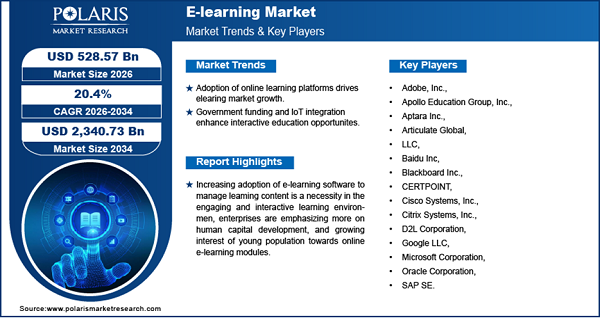
The global E-Learning Market is emerging as a powerhouse in the Information & Communication Technology (ICT) industry — driving digital transformation across education, corporate training, workforce upskilling, and government learning initiatives. With rapid adoption of cloud-based platforms, AI-enabled personalization, and mobile learning solutions, E-Learning is reshaping traditional education and enterprise learning landscapes at an unprecedented scale. According to the latest market insights from Polaris Market Research, the global e-learning market size is projected to grow from USD 439.92 billion in 2025 to a staggering USD 2,340.73 billion by 2034, expanding at a robust CAGR of 20.4 % during 2026–2034.
Rising Demand for Digital Learning Solutions
The COVID-19 pandemic served as a catalyst for the accelerated adoption of digital learning solutions worldwide, demonstrating the potential of online education to provide flexible, scalable, and cost-effective alternatives to traditional classroom instruction. Educational institutions, corporations, and governments are increasingly embracing e-learning platforms to ensure continuity in education, maintain operational agility, and support lifelong learning initiatives.
Several core factors are driving this transformation:
- Accessibility & Flexibility: Learners can access courses and content anytime, anywhere — enabling self-paced and instructor-led learning across devices.
- Cost Efficiency: Online learning significantly reduces infrastructure and operational costs compared to conventional learning environments.
- Technology Integration: Cloud, AI, machine learning, and immersive technologies like AR/VR are enhancing personalization, engagement, and learning outcomes.
- Mobile Learning Penetration: The widespread proliferation of smartphones and improved connectivity fuel on-the-go access to educational resources.
Cloud Dominance and Deployment Models
The cloud-based e-learning segment continues to maintain a leading position as the preferred deployment model, owing to its scalability, reduced infrastructure costs, and ease of access. Cloud solutions empower educational institutions and enterprises with flexible learning environments, continuous updates, and seamless integration of new technologies. In 2025, the cloud segment held the largest market share — a trend expected to persist throughout the forecast period.
Cloud adoption is particularly critical for large institutions and corporations leveraging digital learning for wide-scale training and certifications. As organizations embrace hybrid work models, cloud-enabled learning ecosystems offer uninterrupted access to essential training content and foster collaborative, distributed learning cultures.
Segmentation Insights: Courses & End-Users
The e-learning market spans multiple segments, including primary and secondary education, higher education, online certifications, professional courses, and test preparation. Digital transformation initiatives within K-12 systems and tertiary institutions are expanding the reach of platforms into emerging markets, especially in the Asia Pacific region, which captured the largest revenue share in 2025.
Higher education and professional training segments are also projected to witness substantial growth. With online certification programs gaining recognition among employers, learners increasingly pursue digital credentials to enhance career prospects and meet dynamic skill requirements.
End-user adoption spans academic institutions, corporate enterprises, and government organizations. Corporates are leveraging e-learning tools to enhance employee training, reduce onboarding costs, and improve workforce competencies — a trend that is expected to accelerate as businesses prioritize continuous upskilling.
Regional Growth Dynamics
Regional analysis highlights Asia Pacific as the largest market in terms of revenue share in 2025, driven by increasing internet penetration, government initiatives promoting digital education, and demand for scalable online learning platforms. Meanwhile, North America continues to lead in technological innovation, with well-established digital infrastructure and a high rate of adoption of AI-powered learning tools.
European markets are also progressively investing in e-learning, especially for workforce development and compliance training, while Latin America and Middle East & Africa present substantial growth potential as connectivity improves and digital literacy rises.
Technological Innovation Fueling Engagement
Innovation in e-learning technologies is fundamentally transforming learning experiences. The integration of Artificial Intelligence (AI) enables adaptive and personalized learning pathways, allowing platforms to tailor content to individual learner needs. AI-driven systems automate assessments, provide instant feedback, and support virtual tutors that enhance learner engagement and retention.
Emerging trends include:
- Immersive Learning: Augmented Reality (AR) and Virtual Reality (VR) are being incorporated to create interactive and realistic training environments.
- Gamification: Features like badges, leaderboards, and challenge modules significantly increase learner motivation and participation.
- Mobile-First Learning: With mobile devices serving as primary access points for learners globally, platforms optimized for smartphone use have gained significant traction.
These trends not only elevate the quality of education but also broaden access to underserved populations, fostering digital inclusion and equity in learning.
Competitive Landscape & Key Industry Players
The competitive dynamics within the e-learning market reflect a blend of established technology providers, specialized platform developers, and integrated edtech solutions. Notable companies innovating and expanding their footprint include:
- Aptara Inc.
- Apollo Education Group
- Articulate Global, LLC
- Blackboard Inc.
- Cisco Systems, Inc.
- D2L Corporation
- Citrix Systems, Inc.
- Google LLC
- Oracle Corporation
- Microsoft Corporation
- SAP SE
- Coursera Inc.
- Udemy Inc.
- LinkedIn Learning
- FutureLearn
- Skillsoft Corporation
These players are actively engaging in product innovation, strategic partnerships, and platform enhancements to drive value in both academic and corporate segments. Their efforts to incorporate analytics, AI, and user-centric design principles are setting new benchmarks in the industry.
Future Outlook and Market Potential
As organizations and learners seek flexible, scalable, and technology-driven learning pathways, the e-learning market is poised for exponential growth. By 2034, the projected value of USD 2,340.73 billion underscores the transformational potential of digital learning solutions across industries and regions.
Businesses that invest in AI-optimized learning platforms, immersive experiences, and adaptive learning pathways are expected to gain a competitive edge. Meanwhile, educational institutions that embrace hybrid learning models will continue to deliver quality education beyond geographical constraints.
Ultimately, the global e-learning market represents a cornerstone of digital transformation in the ICT landscape — empowering learners, upskilling workforces, and revolutionizing how knowledge is delivered and consumed worldwide.
For more information, visit https://www.polarismarketresearch.com/industry-analysis/e-learning-market