

Market Summary
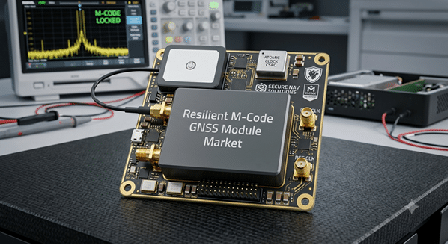
According to latest research by Growth Market Reports, the global Resilient M-Code GNSS Module market size in 2025 stands at USD 1.34 billion, reflecting robust technological adoption across defense and critical infrastructure sectors worldwide. The market is projected to grow at a CAGR of 13.2% from 2026 to 2034, reaching an estimated USD 4.06 billion by 2034. This strong growth trajectory is primarily driven by the escalating need for secure, anti-jamming, and resilient navigation solutions in military and government operations, as well as intensifying threats to conventional GNSS signals from sophisticated adversarial electronic warfare capabilities.
The Resilient M-Code GNSS Module Market is witnessing remarkable growth as governments and defense organizations increasingly prioritize secure, jam-resistant, and high-precision positioning technologies. M-Code-enabled Global Navigation Satellite System (GNSS) modules are designed to provide enhanced anti-jamming, anti-spoofing, and encrypted navigation capabilities for authorized military users. As modern defense operations become more network-centric and electronic warfare threats intensify, resilient M-Code GNSS modules are emerging as an essential component of mission-critical navigation systems.
Key Market Drivers
Rising Defense Modernization Programs
Governments across the globe continue to allocate significant budgets toward defense modernization initiatives. Military forces are replacing legacy navigation systems with secure M-Code-enabled GNSS modules capable of operating under electronic warfare conditions. These upgrades improve battlefield awareness, navigation precision, and operational effectiveness while reducing vulnerability to signal interference.
Increasing Electronic Warfare Threats
The growing sophistication of electronic attacks, including GPS jamming and spoofing, has accelerated demand for resilient navigation technologies. M-Code GNSS modules offer encrypted signals with stronger resistance to intentional disruption, making them indispensable for critical defense applications. The increasing frequency of cyber and electronic warfare incidents continues to reinforce market growth.
Expansion of Autonomous Defense Platforms
Autonomous military vehicles, unmanned aerial systems, unmanned ground vehicles, and autonomous naval vessels require highly reliable positioning systems. Resilient M-Code GNSS modules provide continuous, secure location data that supports autonomous operations even in challenging environments. As defense automation expands, demand for advanced navigation modules is expected to rise substantially.
Market Challenges
High Development and Certification Costs
Developing secure M-Code GNSS modules requires extensive testing, specialized hardware, encrypted software development, and compliance with strict military standards. These complex requirements significantly increase production costs and extend product development timelines, creating barriers for new market entrants.
Restricted Access to Military Technologies
Since M-Code technology is intended primarily for authorized military applications, access to encryption protocols and related technologies remains highly regulated. Export controls and government security policies may limit commercial availability and restrict broader market expansion.
Opportunities for Future Growth
Defense Digitalization Initiatives
The ongoing digital transformation of military operations presents substantial opportunities for resilient GNSS module providers. Digital battlefield management systems, connected defense platforms, and integrated command networks increasingly depend on secure navigation technologies. Future defense infrastructure investments are expected to drive sustained product adoption.
Expansion of Multi-Domain Operations
Modern defense strategies increasingly emphasize coordinated operations across land, sea, air, cyber, and space domains. Secure positioning systems capable of supporting seamless interoperability across multiple operational environments will experience growing demand. Resilient M-Code GNSS modules are well positioned to support these evolving defense doctrines.
Advancements in Satellite Navigation Infrastructure
Continuous improvements in satellite constellations, signal integrity, and navigation resilience are expanding the capabilities of military-grade GNSS systems. These technological enhancements improve operational reliability while enabling next-generation navigation applications across advanced defense equipment.
Competitive Landscape
Raytheon Technologies
BAE Systems
L3Harris Technologies
Honeywell International
Northrop Grumman
Collins Aerospace
General Dynamics
Thales Group
Safran Electronics & Defense
NovAtel (Hexagon)
Future Outlook
The future of the Resilient M-Code GNSS Module Market appears highly promising as secure positioning becomes increasingly vital for modern military operations. The convergence of electronic warfare protection, artificial intelligence, autonomous defense systems, and resilient satellite infrastructure will continue shaping technological innovation.
Growing investments in military modernization, increasing geopolitical uncertainties, and the expanding adoption of secure navigation technologies across multiple defense platforms are expected to sustain strong market momentum through 2034. As defense organizations prioritize resilience, precision, and cybersecurity, resilient M-Code GNSS modules will remain an essential technology supporting next-generation mission success across increasingly complex operational environments.
Source: https://growthmarketreports.com/report/resilient-m-code-gnss-module-market