

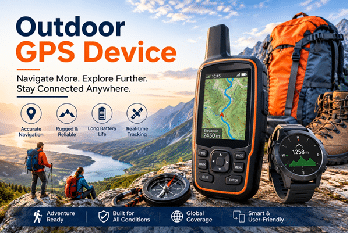
Outdoor GPS Device Market – According to our Growth Market Report, the global Outdoor GPS Device marketsize reached USD 2.9 billion in 2025, reflecting robust demand across consumer, commercial, and government sectors. The market is projected to grow at a CAGR of 8.1% from 2026 to 2034, reaching an estimated USD 5.8 billion by 2034. This growth is primarily driven by the increasing adoption of location-based services, advancements in multi-constellation satellite technology, and the rising popularity of outdoor recreational activities worldwide. As per our latest research, the Outdoor GPS Device market is undergoing a significant transformation, fueled by technological innovations and expanding applications across diverse industries including logistics, defense, marine navigation, and adventure sports.
Introduction: Why Outdoor GPS Devices Are Becoming More Essential Than Ever
Outdoor exploration has evolved dramatically over the past decade. Whether trekking through remote mountain ranges, conducting environmental surveys, navigating dense forests, or coordinating emergency rescue operations, reliable positioning technology has become indispensable. The Outdoor GPS Device Market is expanding beyond recreational navigation, serving professionals, researchers, military personnel, conservationists, and adventure enthusiasts who require dependable location tracking regardless of cellular connectivity.
Unlike smartphones that rely on battery-intensive applications and network coverage, dedicated outdoor GPS devices are purpose-built to withstand harsh environments while delivering accurate navigation, route planning, and emergency support. As outdoor tourism continues to grow globally and industries increasingly rely on field-based operations, demand for rugged navigation technology is accelerating.
What Is an Outdoor GPS Device?
An outdoor GPS device is a handheld or wearable navigation instrument that communicates directly with Global Navigation Satellite Systems (GNSS) such as GPS, GLONASS, Galileo, and BeiDou. These devices provide real-time positioning, mapping, waypoint management, altitude information, and route guidance without requiring mobile network connectivity.
Designed for durability, outdoor GPS devices typically feature waterproof construction, shock resistance, sunlight-readable displays, extended battery life, and compatibility with downloadable topographic maps. Their reliability makes them valuable across both recreational and mission-critical environments.
Why Dedicated GPS Devices Continue to Thrive in the Smartphone Era
Many people assume smartphones have replaced dedicated GPS units. However, experienced outdoor users understand the limitations of relying solely on mobile devices during extended expeditions.
Dedicated outdoor GPS devices offer significantly longer battery life, enhanced durability, stronger satellite reception under dense tree cover, and operation independent of cellular networks. They also provide specialized navigation functions such as breadcrumb trail tracking, geocaching support, barometric altitude measurements, and emergency waypoint marking.
For professionals working in isolated environments, these capabilities often determine operational success and user safety.
Key Technologies Driving the Outdoor GPS Device Market
Multi-GNSS Compatibility
Modern outdoor GPS devices no longer depend exclusively on the American GPS satellite network. Today’s advanced models integrate multiple satellite constellations simultaneously, improving positioning accuracy even in valleys, dense forests, urban canyons, or mountainous terrain.
The combination of GPS, Galileo, GLONASS, and BeiDou allows faster satellite acquisition and more reliable navigation under challenging environmental conditions.
High-Resolution Digital Mapping
Outdoor mapping has become significantly more sophisticated. Users can now access detailed topographic maps featuring elevation contours, water bodies, trails, campsites, roads, vegetation, and protected wildlife areas.
Many devices support downloadable regional maps, allowing travelers to customize navigation based on their destination.
Satellite Communication Integration
One of the most significant innovations in recent years is satellite communication capability.
Certain advanced outdoor GPS devices now enable users to send emergency SOS alerts, exchange text messages, and share live locations through satellite networks. This functionality enhances safety during expeditions where cellular service is unavailable.
Such capabilities are increasingly valued by solo hikers, mountaineers, sailors, and scientific research teams operating in remote locations.
Growing Applications Across Multiple Industries
Adventure Tourism
Outdoor recreation remains the largest consumer segment. Hiking, camping, mountaineering, trail running, cycling, kayaking, skiing, and hunting all benefit from reliable navigation equipment.
As global adventure tourism continues expanding, consumers increasingly seek navigation devices capable of operating across varied terrains and climates
Forestry and Environmental Conservation
Forestry professionals rely on GPS devices to mark boundaries, monitor forest health, track wildlife habitats, and conduct biodiversity assessments.
Environmental organizations also use GPS technology for reforestation initiatives, ecosystem restoration, invasive species management, and climate research.
Agriculture and Land Surveying
Field surveyors require highly accurate location data for land measurement, infrastructure planning, and agricultural mapping.
Outdoor GPS devices simplify boundary identification, irrigation planning, soil sampling, and crop monitoring while improving operational efficiency.
Search and Rescue Operations
Emergency response agencies increasingly depend on rugged GPS devices during disaster management and rescue missions.
These tools help responders navigate difficult terrain, locate victims, establish safe evacuation routes, and coordinate teams operating across large geographic areas.
Reliable navigation remains critical when every minute counts.
Military and Defense
Defense organizations continue investing in highly secure outdoor navigation equipment designed for tactical missions.
Military-grade GPS devices often feature encrypted positioning, night-vision compatibility, enhanced durability, and operation under extreme environmental conditions.
Artificial Intelligence Is Enhancing Outdoor Navigation
Artificial intelligence is beginning to transform GPS technology from simple navigation into intelligent decision-making systems.
AI-powered outdoor GPS devices can analyze terrain difficulty, recommend safer hiking routes, estimate arrival times based on elevation changes, detect unusual movement patterns, and optimize energy consumption.
Future devices may automatically identify hazardous weather conditions, avalanche-prone regions, flood risks, or wildlife activity using integrated environmental data.
Sustainability Is Influencing Product Development
Manufacturers are increasingly focusing on environmentally responsible product design.
Energy-efficient processors, recyclable materials, replaceable batteries, solar charging compatibility, and longer product lifecycles are becoming attractive features for environmentally conscious consumers.
Reducing electronic waste while improving device longevity aligns with broader sustainability objectives across the outdoor equipment industry.
Challenges Affecting Market Growth
Despite promising opportunities, several factors continue influencing market development.
Smartphone navigation applications remain a competitive alternative for casual users. Price sensitivity in developing regions may also limit adoption of premium GPS devices.
Manufacturers must continuously balance advanced functionality with affordability while maintaining durability, battery efficiency, and mapping accuracy.
Frequent software updates and evolving satellite technologies also require ongoing investment in research and product development.
Emerging Opportunities Creating Long-Term Growth
According to our Growth Market Report, Integration with wearable fitness ecosystems, drone mapping platforms, augmented reality guidance, environmental sensors, cloud-based route synchronization, and predictive analytics will unlock entirely new user experiences.
Commercial sectors including infrastructure inspection, renewable energy maintenance, pipeline monitoring, scientific exploration, and autonomous field operations are expected to become increasingly important customers.
As digital transformation reaches more outdoor industries, GPS devices will evolve into comprehensive field intelligence platforms.
Source:- https://growthmarketreports.com/report/outdoor-gps-device-market