

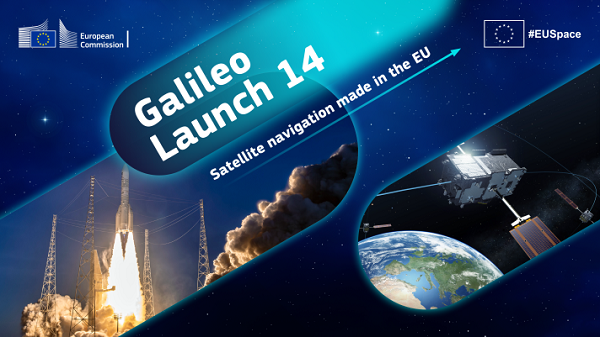
Today, Europe will be adding two new satellites to the Galileo mission, as a milestone that will strengthen the strategic autonomy of the European Union (EU). This 14th launch (L14) will take place on board an Ariane 6 rocket, and it will enhance the critical positioning, navigation, and time synchronization services that are used by more than 4 billion devices worldwide.
Spain will be playing an essential role, thanks to GMV’s leadership in developing the ground control segment, which keeps the constellation operational 24 hours a day while also providing support during the launching of new satellites.
Galileo L14: another step forward for Europe’s technological autonomy
The addition of these two satellites is taking place at a significant moment. Some of the older Galileo satellites are now approaching the end of their lifespan, and the new satellites will make it possible to maintain the service availability levels offered by the system.
This is also one of the last three launches currently planned for Galileo first-generation satellites, since the next launches will be for Galileo second-generation (G2G) satellites that offer new capabilities, improved precision, and more robustness against signal interference and cyber threats. This launch also represents an important milestone for Europe’s new Ariane 6 launcher, which is helping to ensure European strategic autonomy in access to space after retirement of the Ariane 5.
The importance of Galileo in our lives
Galileo has a direct impact on the daily activities of billions of people all over the world, because although they might not always realize it, they routinely use the system’s services for numerous applications, such as:
- Navigation in complex urban environments, with greater precision and more robustness against signal interference.
- Advanced driver-assistance systems, which are improving road safety.
- Precision agriculture, which can reduce emission levels and optimize the use of water, fertilizers, and seeds.
- Synchronization for electrical grids and telecommunications networks, where the precise time synchronization service offered by Galileo is an essential part of guaranteeing service quality.
- Emergency services such as eCall, to allow accurate determination of the location of vehicles involved in an accident.
- Logistics operations and autonomous drone flights, as ways of promoting safer and more intelligent mobility.
In short, Galileo has become an essential part of the infrastructure that is needed for multiple industries, essential services, and emerging technological solutions.
GMV: Spanish leadership at the operational heart of Galileo
Operation of the Galileo system requires complex, highly secure infrastructure on the ground, in order to continuously monitor the status of each satellite. This ground segment also allows planning and execution of the necessary maneuvers, protection of service quality, and immediate responses to any anomalies detected.
Since 2018, GMV has been leading development of the ground control segment for the Galileo first generation (G1G) and second generation (G2G) satellites. This is a critical part of the system, and at the control centers in Oberpfaffenhofen (Germany) and Fucino (Italy), the solutions developed by GMV are now making it possible to:
- Continuously monitor each satellite’s health and position.
- Manage the orbital maneuvers that are essential for maintaining the system’s stability.
- Ensure the security of the signals being received by billions of users.
- Provide uninterrupted (24/7) operation of the constellation.
- Perform monitoring and command functions for deployment of new satellites after their separation from the launcher.
In addition, since 2023 GMV has been developing the G2STB test bench, which is a key environment for validating the improvements made to the second-generation satellites and the new services they will provide.
The strategic importance of Galileo in a changing world Galileo is a cutting-edge program from a technological perspective, and it is also giving Europe autonomy in a global context marked by geopolitical tensions, hybrid threats,
and increasing levels of competition in space. By having its own system, Europe can keep essential services available even in times of crisis, when the services provided by other constellations, such as GPS or GLONASS, may be affected by political decisions or operational limitations. With the L14 launch, Europe is not just expanding its Galileo constellation. It is also taking another step forward in solidifying a strategic project that brings together the latest technologies to produce an international impact, while enhancing the EU’s strategic autonomy in an increasingly uncertain world.
Statements by Miguel Romay, General Manager of GMV’s satellite Navigation Systems
“This launch marks a turning point for Galileo: not only does it guarantee that the constellation will continue to offer the current level of service, but it also opens the door to a new technological era. The second generation will bring a qualitative leap in precision and in the ability to operate in increasingly demanding environments.”
“GMV’s work ensures that the constellation is operational 24 hours a day, seven days a week, and that millions of users around the world have a reliable and secure service.”
“In such a volatile global scenario, having an independent European system is not a privilege, it is a necessity. Galileo provides Europe with a critical capability to protect its essential services and make decisions without depending on third parties.”
“This new launch confirms that Europe is making steady progress in its space ambitions. The evolution of Galileo shows that we are capable of developing strategic infrastructures that strengthen our security, our economy, and our international presence.”
At a glance:
▪ Scheduled launch: December 17, 2025
▪ Satellites: 2 FOC (First Generation)
▪ Launcher: Ariane 6
▪ Galileo users worldwide: more than 4 billion
▪ Services provided: critical positioning, navigation, and time synchronization
▪ Ground control segment: led by GMV
▪ Control centers: Oberpfaffenhofen (Germany) and Fucino (Italy)
▪ Next milestones: L15, L16, and the transition to Galileo second gen