

Market Summary
According to our Growth Market Report, the global UAV Navigation System market size reached USD 4.2 billion in 2024 and is projected to grow at a robust CAGR of 14.7% from 2025 to 2033. By the end of the forecast period, the market is expected to reach USD 13.1 billion by 2033. This impressive growth trajectory is primarily driven by the rapid proliferation of unmanned aerial vehicles (UAVs) across both military and commercial domains, the integration of advanced navigation technologies, and the expanding scope of UAV applications in diverse industries.
Introduction
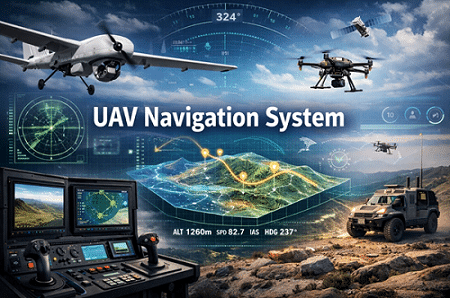
The evolution of unmanned aerial vehicles (UAVs) has transformed industries ranging from defense and agriculture to logistics and infrastructure inspection. At the heart of this technological revolution lies the UAV navigation system—a sophisticated combination of hardware and software that enables drones to determine their position, plan routes, and operate autonomously in complex environments.
As UAV adoption accelerates worldwide, navigation systems are becoming more advanced, integrating artificial intelligence, satellite technologies, and sensor fusion. These innovations are enabling drones to perform missions with exceptional accuracy, reliability, and safety.
The UAV Navigation System Market is gaining strong momentum as governments, commercial enterprises, and research institutions increasingly invest in autonomous aerial capabilities.
Understanding UAV Navigation Systems
A UAV navigation system is responsible for determining a drone’s location, direction, speed, and trajectory during flight. It ensures that the drone follows a predefined path or dynamically adapts to environmental conditions.
Modern navigation systems combine multiple technologies to ensure precise positioning and stability.
Key Components of UAV Navigation Systems
Global Navigation Satellite Systems (GNSS)
Satellite navigation technologies provide accurate geolocation data. Systems such as GPS, GLONASS, Galileo, and BeiDou enable drones to determine their global position.
Inertial Navigation Systems (INS)
INS uses accelerometers and gyroscopes to measure motion and orientation. It is particularly useful when satellite signals are weak or unavailable.
Sensor Fusion Modules
These modules combine data from GNSS, INS, cameras, LiDAR, and radar to create a reliable navigation solution.
Flight Control Systems
These systems process navigation data and translate it into commands for motors and control surfaces, ensuring stable flight.
Artificial Intelligence Algorithms
AI enables autonomous path planning, obstacle avoidance, and adaptive navigation in dynamic environments.
Market Drivers Accelerating Growth
The UAV Navigation System Market is expanding rapidly due to several powerful growth drivers.
Rising Demand for Autonomous Drones
Industries are increasingly adopting autonomous drones to improve operational efficiency and reduce human intervention. Reliable navigation systems are critical to enabling fully autonomous missions.
Expansion of Drone Applications
UAVs are now widely used in agriculture, mining, energy, logistics, environmental monitoring, disaster management, and urban planning. Each application requires accurate navigation technologies to ensure mission success.
Growth of Defense and Security Investments
Military organizations around the world rely heavily on UAVs for surveillance, reconnaissance, and tactical operations. Advanced navigation systems are essential for operating in contested or GPS-denied environments.
Technological Advancements in Sensors and AI
Continuous innovation in sensors, AI-driven navigation algorithms, and real-time data processing is significantly enhancing the capabilities of UAV navigation systems.
Emerging Technological Trends
The UAV Navigation System Market is evolving quickly as new technologies reshape drone capabilities.
AI-Based Autonomous Navigation
Artificial intelligence is enabling drones to analyze real-time environmental data and make intelligent navigation decisions without human input.
GPS-Denied Navigation
Drones are increasingly being designed to operate in environments where GPS signals are unavailable or jammed. Vision-based navigation, LiDAR mapping, and SLAM (Simultaneous Localization and Mapping) technologies are becoming essential.
Integration of Edge Computing
Edge computing allows navigation data to be processed directly on the drone rather than relying on cloud infrastructure. This reduces latency and improves real-time decision-making.
Multi-Sensor Navigation Architecture
Modern drones are incorporating multiple sensors such as LiDAR, radar, optical cameras, and ultrasonic sensors to ensure robust navigation even in challenging conditions.
Key Application Areas
UAV navigation systems are enabling new capabilities across a wide range of industries.
Defense and Military
Military UAVs rely on advanced navigation technologies for intelligence gathering, border monitoring, and combat missions. These systems require extremely high precision and reliability.
Agriculture
Precision agriculture drones use navigation systems to monitor crop health, perform aerial spraying, and map farmland with centimeter-level accuracy.
Logistics and Delivery
Companies exploring drone delivery solutions depend on highly accurate navigation systems to ensure safe package transportation in urban environments.
Infrastructure Inspection
Drones equipped with advanced navigation systems are increasingly used to inspect bridges, power lines, wind turbines, and pipelines.
Disaster Response and Emergency Management
During natural disasters, UAVs provide real-time aerial imagery and situational awareness. Navigation systems enable drones to operate safely in hazardous environments.
Challenges Impacting the Market
Despite strong growth potential, the UAV Navigation System Market faces several challenges.
Regulatory Restrictions
Airspace regulations and drone operation guidelines vary widely across countries, creating challenges for global UAV deployment.
Navigation Reliability in Complex Environments
Urban environments, dense forests, and indoor spaces pose navigation challenges due to signal interference and obstacles.
Cybersecurity Risks
As UAV systems become more connected, protecting navigation data from cyber threats is becoming increasingly important.
Competitive Landscape
- Honeywell International Inc.
- Northrop Grumman Corporation
- Raytheon Technologies Corporation
- Thales Group
- Safran Electronics & Defense
- Garmin Ltd.
- Trimble Inc.
- BAE Systems plc
- General Electric Company
- Collins Aerospace
- Lockheed Martin Corporation
- Cobham Limited
- u-blox Holding AG
- KVH Industries, Inc.
- Sagem (Safran Group)
- Moog Inc.
- Rockwell Collins (now part of Collins Aerospace)
- Sparton Corporation
- Advanced Navigation
- Topcon Corporation
Future Outlook
According to our Growth Market Report, The future of the UAV Navigation System Market is closely tied to the broader evolution of autonomous systems and smart mobility.
Over the next decade, navigation systems will become more intelligent, adaptive, and resilient. Technologies such as quantum navigation, swarm intelligence, and AI-driven flight autonomy are expected to redefine drone capabilities.
Additionally, the integration of UAVs with smart cities, digital twins, and next-generation communication networks will create new opportunities for navigation system providers.
As global industries continue to embrace automation and aerial intelligence, UAV navigation systems will remain the technological backbone that enables safe, efficient, and autonomous flight.
Source:- https://growthmarketreports.com/report/uav-navigation-system-market