


We tend to think of GPS as an unshakeable constant. It is the invisible utility that powers everything from our morning commute to global supply chains and financial markets. For decades, we have relied on the exclusivity of satellites in Medium Earth Orbit (MEO), roughly 12,000 miles above our heads. They have done a commendable job. But let’s be honest about the reality we face in today’ turbulent world. That exclusivity is becoming a risk, and the solution is getting much closer to home.
We are witnessing a massive shift toward Low Earth Orbit (LEO) constellations. This is not just about adding more dots to the sky. It offers a fundamental change in how we think about position, navigation, and timing (PNT).
The Problem with Distance
To understand why LEO is taking off, you have to look at the limitations of our current MEO infrastructure. Distance and power efficiency are the main enemies. When a low strength signal has to travel over 12,000 miles to reach a receiver, it arrives looking very different than when it left. It is weak. It is susceptible to interference.
In the industry, we have seen how fragile these signals can be. You can buy a jamming device online right now for under a hundred dollars. We saw a case recently where a truck driver used a cheap jammer to hide his location from his employer. He parked near an airport, turned on the device, and inadvertently overpowered navigation signals for a mile-wide radius, impacting civil aviation and causing aircraft revert to inertial navigation.
If a cheap gadget can disrupt critical infrastructure, imagine what a sophisticated bad actor can do. The geopolitical situation in Eastern Europe has already shown us that jamming and spoofing are standard operational procedures in modern conflict. The inherently weak power levels and design for global coverage of GNSS signals from MEO is simply too easy to shout down.
The LEO Advantage
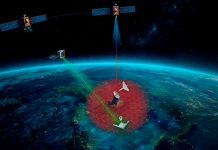
This is where Low Earth Orbit changes the game. We are talking about satellites orbiting between 300 and 1,200 miles up. The physics are simple. Because they are closer, the signal is stronger. It is harder to jam and harder to spoof, while improving reception in urban canyons, under foliage, indoors, and polar regions where MEO GNSS struggles.
It also brings a massive improvement in accuracy and resilience. Faster orbital dynamics provide more frequent geometry updates, enabling quicker convergence to high accuracy (centimeter to decimeter levels), and better support for dynamic applications like autonomous vehicles. While higher power signals, frequency diversity across multiple bands, and rapid satellite pass-overs enhance resilience against jamming, spoofing, and interference, critical for military, public safety, and critical infrastructure.
The market sees this potential. We are looking at a sector expected to balloon to over $55 billion in the next decade. This growth is driven by a hunger for broadband, but the navigation piece is rapidly becoming just as critical.
A Complement, Not a Replacement
While many people have the mistaken impression that the new generation of LEO satellite constellations will replace older, traditional GPS (Global Positioning System) systems, that is not entirely true. The relationship between LEO and MEO GNSS is better described as an multi-layered association in which each partner relies on the other.
LEO satellites already use the same MEO provided PNT signals to determine their orientation and send messages back to Earth. However, they can then retransmit and amplify the GNSS data they received to users with far greater signal strength.
In addition, a new breed of LEO satellites is uniquely delivering PNT payloads independent of the MEM constellations.
The partnership between traditional GNSS and new LEO PNT is essentially a redundancy/resilience plan to deliver robust, global coverage. In contrast to relying on the exclusivity of MEO (Medium Earth Orbit) satellites, we are now using a multi-layered augmentation model. In the event the MEO signal is jammed or otherwise obstructed, the LEO layer bridges the gap by providing a redundant means for users to continue using services that depend on the MEO signal. This redundancy is augmented by more frequent and powerful signals providing a level of business continuity and enhanced accuracy that the traditional, MEO systems do not.
The New Business of Orbit
For the satellite operators, this is a golden opportunity. Launching constellations is expensive. To make the math work, these companies need to maximize the value of every piece of hardware they send up.
We are seeing a trend where PNT is becoming a valuable “additional payload”. A satellite might be launched primarily for broadband internet, but with the right timing and positioning technology on board, it becomes a dual-use asset. It allows operators to monetize their fleets in new ways by selling high-accuracy, jam-resistant navigation services to enterprise and government clients.
Looking Ahead
The exclusivity of Medium Earth Orbit is over. The reliance on a distant, vulnerable signal was a risk we accepted because of the world we used to live in. Now things have changed. The future of navigation is not about replacing what works. It is about fortifying it. By bringing our infrastructure closer to Earth, we are making it faster, stronger, and significantly more difficult to disrupt. For anyone managing critical systems, the question is no longer whether to consider LEO solutions, but how quickly you can integrate them.
For more information, visit www.spirent.com.