

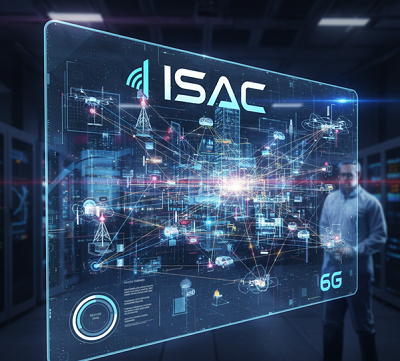
According to Research Intelo, the Global ISAC for 6G market size was valued at $1.2 billion in 2024 and is projected to reach $18.7 billion by 2033, expanding at an impressive CAGR of 35.6% during the forecast period of 2025–2033. The major factor driving the robust growth of the ISAC for 6G market globally is the surging demand for integrated sensing and communication (ISAC) capabilities in next-generation wireless networks. This demand is being fueled by the convergence of advanced communication systems with high-precision sensing, enabling a wide array of applications in telecommunications, automotive, industrial automation, and defense. As 6G technology continues to evolve, the integration of ISAC is set to revolutionize how information is transmitted and sensed simultaneously, providing unprecedented efficiency, security, and user experiences across multiple industries.
Integrated Sensing and Communication (ISAC) is rapidly emerging as one of the most transformative technologies underpinning next-generation wireless networks. At its core, ISAC enables wireless systems to perform communication and environmental sensing simultaneously using the same hardware, spectrum, and signal processing frameworks. As the global telecommunications ecosystem prepares for the commercial rollout of sixth-generation (6G) networks, the ISAC for 6G market is becoming a major focal point for governments, research institutions, and technology vendors. This market sits at the intersection of radar sensing, real-time data exchange, and artificial intelligence, creating a new category of intelligent wireless infrastructure.
Market Evolution and Technology Foundations
The ISAC for 6G market has evolved from earlier research into joint radar-communication (JRC) systems and vehicle-to-everything (V2X) sensing. The rapid increase in connected devices, autonomous machines, and smart city architectures has pushed traditional communication systems to their limits. In response, ISAC offers a unified architecture that combines sensing waveforms and communication signals, enabling more efficient use of spectrum and hardware.
At the foundation of this market are advanced antenna arrays, millimeter-wave and sub-terahertz frequency bands, and highly miniaturized radio-frequency (RF) front-end components. Massive multiple-input multiple-output (MIMO) and reconfigurable intelligent surfaces (RIS) are playing a critical role in shaping beam patterns that can simultaneously transmit data and collect environmental feedback. These technological pillars are opening commercial opportunities for chipset manufacturers, infrastructure providers, and software-defined network developers.
Key Applications Driving Market Expansion
The ISAC for 6G market is being propelled by a broad set of applications that require both ultra-reliable communications and situational awareness. Autonomous transportation is one of the most influential drivers. Self-driving vehicles benefit from ISAC-enabled roadside units and in-vehicle systems that can detect obstacles, track pedestrian movement, and communicate with surrounding infrastructure in real time.
Another major application area is smart manufacturing. Industrial environments increasingly rely on collaborative robots, automated guided vehicles, and high-precision monitoring systems. ISAC-enabled 6G networks can provide centimeter-level positioning, real-time equipment diagnostics, and predictive maintenance by sensing machine vibrations and spatial layouts.
In healthcare, ISAC can support contactless patient monitoring, indoor navigation for medical staff, and emergency response coordination. By integrating sensing directly into the network fabric, hospitals and care facilities can achieve both higher safety and operational efficiency without deploying separate radar and sensor networks.
Challenges and Barriers to Commercial Adoption
Despite its strong promise, the ISAC for 6G market faces several technical and commercial challenges. One of the most critical issues is interference management. Sharing the same spectrum for sensing and communication increases the complexity of signal design and requires highly sophisticated algorithms to avoid performance degradation.
Hardware cost and power consumption are additional barriers. ISAC-capable devices must handle higher processing loads, advanced beamforming, and real-time analytics, all of which increase system complexity. This can slow adoption in cost-sensitive markets.
There are also standardization challenges. ISAC requires new global standards to ensure interoperability across devices, vendors, and borders. The absence of mature, unified standards may delay commercial scalability in the near term.
Future Outlook and Market Opportunities
Looking ahead, the ISAC for 6G market is expected to transition from experimental deployments to commercial-grade infrastructure as technology costs decline and standards mature. The convergence of sensing, communication, and AI will unlock new business models, such as network-as-a-sensor services, spatial data marketplaces, and real-time digital twins of physical environments.
Telecom operators are likely to monetize ISAC capabilities by offering premium services to industries that require high-precision localization and environmental intelligence. At the same time, startups and software innovators will find opportunities in developing specialized analytics platforms and intelligent network orchestration tools.
As societies become increasingly dependent on autonomous systems, real-time data, and connected infrastructure, ISAC will evolve from a niche research concept into a foundational pillar of the 6G ecosystem.
Competitive Landscape
Prominent companies operating in the market are:
- Apple Inc.
- Samsung Electronics Co., Ltd.
- Huawei Technologies Co., Ltd.
- Nokia Corporation
- Ericsson AB
- Qualcomm Technologies, Inc.
- ZTE Corporation
- NEC Corporation
- Intel Corporation
- Cisco Systems, Inc.
- SK Telecom Co., Ltd.
- LG Electronics Inc.
- Fujitsu Limited
- NVIDIA Corporation
Source: https://researchintelo.com/report/isac-for-6g-market