

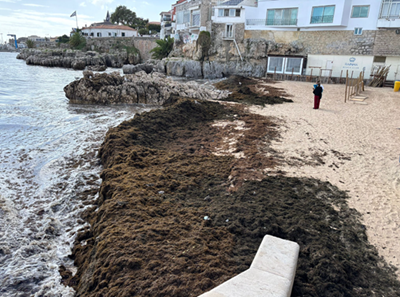
Rugulopteryx okamurae Invasive Seaweed – An invasive seaweed species originating from the Pacific Ocean is silently advancing along the Portuguese coastline and already poses a growing threat to beaches, marine biodiversity, and economic activity.
To address this challenge, the Municipality of Cascais is investing in an innovative solution based on space technology, artificial intelligence, and ocean science, capable of predicting when and where the seaweed is likely to reach the coast.
The project, known as EO4RO (Earth Observation for the Mapping and Monitoring of Rugulopteryx okamurae), will be carried out over a 12-month period by a consortium comprising GMV Portugal and Plymouth Marine Laboratory, one of the world’s leading marine research institutions. The initiative is funded by the Municipality of Cascais.
The invasive species Rugulopteryx okamurae, a brown seaweed native to the Pacific coast of Asia, was first detected in the Mediterranean Sea in 2002 and has since spread rapidly into the Atlantic. In recent years, it has accumulated along several European coastal areas, generating significant clean-up costs, affecting tourism, creating challenges for the fishing sector, and degrading natural habitats.
“This collaboration demonstrates the potential of cooperation between science, technology, and local government to address emerging environmental challenges. Cascais is committed to remaining at the forefront of innovation applied to the protection and sustainable management of coastal areas,” says Nuno Piteira Lopes, Mayor of Cascais.
Anticipating the Problem Before It Reaches the Shore
At present, monitoring efforts are largely reactive, with action taken only after the seaweed has already reached the coastline. EO4RO aims to reverse this approach by enabling authorities to anticipate proliferation events and coastal accumulation episodes before they occur.
By combining satellite imagery, oceanographic data, meteorological information, and artificial intelligence algorithms, the system will assess its ability to:
- Predict blooms and coastal accumulation events.
- Map the extent of the invasion in near real time.
- Simulate seaweed transport driven by ocean currents and wind.
- Identify and map affected marine habitats.
- Issue automatic alerts to authorities and the public.
This same technological approach is already being used in critical applications such as oil spill forecasting, environmental monitoring, and the analysis of extreme events.
“We are applying technologies developed to address global challenges to a very specific problem affecting beaches, ecosystems, and local economies. Innovation delivers its true value when it improves people’s lives and helps protect the environment,” says Filipe Brandão, Senior Project Manager at GMV in Portugal.
Space Technology Serving Communities
GMV has a strong presence in the space sector and decades of experience in Earth Observation and geospatial analytics. The company has extensive expertise within the Copernicus programme, where it has developed, operated, and maintained mission planning systems for Sentinel-1, Sentinel-2, Sentinel-3, Sentinel-6, and CO2M throughout their entire life cycle. GMV also collaborates with leading institutions such as the European Space Agency (ESA).
Plymouth Marine Laboratory is internationally recognised for its scientific work in oceanography and for the use of space-based data applied to the marine environment.
Cascais could become a European benchmark
If the results are positive, Cascais could become the first Portuguese municipality to trial an integrated solution of this kind and a European case study in smart coastal management.
The model could be replicated in other vulnerable areas, from the Algarve to the Canary Islands, and from the Mediterranean to the North Atlantic.
“If we manage to predict the problem before it occurs, we will save time, reduce public expenditure and improve environmental protection. That is the true potential of this project,” concludes Filipe Brandão.
For more information visit: www.gmv.com.