

Flip Chip Technology Market – The semiconductor industry is experiencing a period of rapid transformation as consumer electronics continue to evolve toward higher performance, compact designs, and greater energy efficiency. From smartphones and wearables to gaming consoles and advanced computing devices, manufacturers are constantly seeking packaging technologies that enable faster processing, improved thermal performance, and smaller footprints. Among the technologies reshaping semiconductor packaging, flip chip technology market has emerged as a preferred choice for supporting the increasing complexity of modern electronic systems.
The growing integration of artificial intelligence, high-speed connectivity, and miniaturized components in electronic products is creating strong demand for advanced chip packaging solutions. Flip chip packaging allows semiconductor devices to deliver improved electrical performance while supporting higher input and output density. As electronic devices become smaller and more powerful, industries are increasingly turning toward packaging technologies capable of addressing performance limitations associated with traditional interconnection methods.
Growing Importance of Advanced Semiconductor Packaging in Consumer Electronics
Consumer electronics manufacturers are facing intense pressure to introduce devices that offer better speed, enhanced battery life, and advanced functionality while maintaining slim form factors. Traditional semiconductor packaging methods often struggle to accommodate these requirements because increasing circuit density creates thermal and performance challenges.
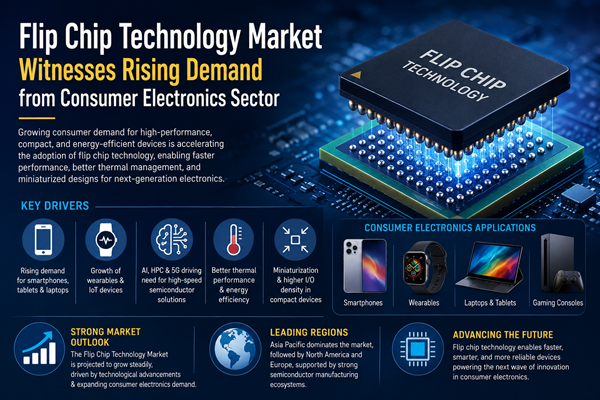
Flip chip technology addresses these limitations by allowing semiconductor dies to be directly connected to substrates using conductive bumps. This design significantly shortens electrical pathways, reduces signal delays, and improves power efficiency. These advantages are becoming particularly valuable for smartphones, tablets, wearable devices, laptops, and gaming systems where compactness and performance are equally important.
As product cycles shorten and innovation accelerates, semiconductor companies are prioritizing packaging technologies that support rapid product development and scalability. The ability to integrate multiple functionalities within limited space is becoming one of the strongest growth drivers for advanced chip packaging adoption.
Why Smartphones Continue to Drive Demand for Flip Chip Packaging
The smartphone industry remains one of the largest consumers of semiconductor components, creating substantial opportunities for advanced packaging technologies. Modern smartphones require highly integrated chipsets capable of supporting artificial intelligence applications, high-resolution cameras, 5G connectivity, and immersive multimedia experiences.
To accommodate these capabilities, manufacturers are adopting packaging solutions that maximize performance while minimizing power consumption. Flip chip technology supports these objectives by enabling better thermal management and higher signal integrity compared to conventional wire-bond packaging.
Mobile device manufacturers are increasingly incorporating more sensors, processors, and memory modules into smaller spaces. This shift is encouraging semiconductor companies to invest in packaging innovations that support miniaturization without compromising device efficiency or reliability.
Expansion of Wearable Devices and IoT Ecosystems Supporting Market Growth
The rapid adoption of wearable devices and connected technologies is creating new opportunities for semiconductor packaging providers. Smartwatches, fitness trackers, smart glasses, and health monitoring devices require lightweight and compact components that can operate efficiently within small form factors.
Wearable electronics place significant emphasis on battery optimization and thermal efficiency because device size restrictions limit hardware flexibility. Advanced chip packaging solutions help manufacturers meet these challenges by enabling better electrical performance and reducing overall package size.
The expansion of Internet of Things ecosystems is also accelerating semiconductor demand across multiple industries. Connected home devices, industrial sensors, and smart appliances increasingly rely on compact integrated circuits that require efficient packaging technologies capable of supporting continuous operation and high reliability.
Role of Artificial Intelligence and High-Performance Computing in Technology Adoption
Artificial intelligence workloads are placing greater demands on semiconductor performance. Applications such as machine learning, generative AI, computer vision, and real-time analytics require processors capable of handling large amounts of data while maintaining speed and energy efficiency.
As computing requirements become more complex, semiconductor manufacturers are exploring packaging methods that improve bandwidth and processing capabilities. Advanced packaging designs support faster data transmission between chips, making them highly suitable for AI accelerators and computing-intensive applications.
The rise of edge computing is further increasing packaging requirements because devices now process larger volumes of information locally rather than relying entirely on cloud infrastructure. This shift requires compact semiconductor solutions that deliver high computing performance within restricted physical spaces.
Automotive Electronics and 5G Infrastructure Create New Opportunities
Beyond consumer electronics, automotive systems and telecommunications infrastructure are becoming major contributors to advanced semiconductor demand. Electric vehicles, advanced driver assistance systems, and autonomous technologies require highly reliable semiconductor components capable of operating under challenging conditions.
Modern vehicles incorporate increasing numbers of sensors, processors, and communication modules. Packaging technologies that improve thermal performance and reliability are becoming essential for supporting these sophisticated electronic architectures.
Similarly, the expansion of 5G infrastructure requires semiconductors capable of handling high-frequency communications and increased data loads. Telecommunications equipment manufacturers are investing heavily in packaging solutions that enable improved signal performance and energy efficiency.
Manufacturing Challenges and Cost Considerations
Despite significant advantages, advanced packaging technologies face certain operational challenges. Manufacturing complexity remains a critical factor because production processes require high precision and sophisticated equipment.
The cost associated with packaging infrastructure can create barriers for smaller semiconductor manufacturers. Advanced assembly processes often involve specialized substrates, wafer bumping technologies, and inspection systems that increase overall production expenses.
Supply chain disruptions can also affect packaging availability because semiconductor manufacturing relies heavily on globally distributed suppliers. Companies continue investing in localized manufacturing strategies to improve supply chain resilience and reduce dependency risks.
Regional Dynamics Influencing Industry Expansion
Asia Pacific remains a major hub for semiconductor manufacturing due to strong electronics production capabilities and large-scale investments in fabrication facilities. Countries across the region continue expanding semiconductor ecosystems to support rising global demand for advanced electronic products.
North America remains an important innovation center driven by strong investments in AI technologies, cloud computing infrastructure, and semiconductor research initiatives. Meanwhile, Europe is witnessing increased activity in automotive electronics and industrial automation applications.
Regional government initiatives supporting semiconductor self-sufficiency are expected to accelerate investments across packaging technologies, manufacturing infrastructure, and research capabilities over the coming years.
Future Outlook for Semiconductor Packaging Technologies
The future of semiconductor packaging is increasingly tied to performance optimization, miniaturization, and integration efficiency. As electronic devices continue evolving, manufacturers will require packaging technologies capable of supporting increasingly sophisticated architectures.
According to insights frequently highlighted by Persistence Market Research, semiconductor packaging innovations are becoming central to enabling next-generation computing applications. Industry participants are expected to focus on improving thermal management, reducing manufacturing costs, and increasing packaging density.
The continued rise of consumer electronics, connected devices, AI-enabled applications, and advanced communication networks is expected to sustain strong momentum for the Flip Chip Technology Market. As industries pursue higher performance within smaller form factors, packaging technologies that support speed, efficiency, and reliability will remain at the center of semiconductor innovation.